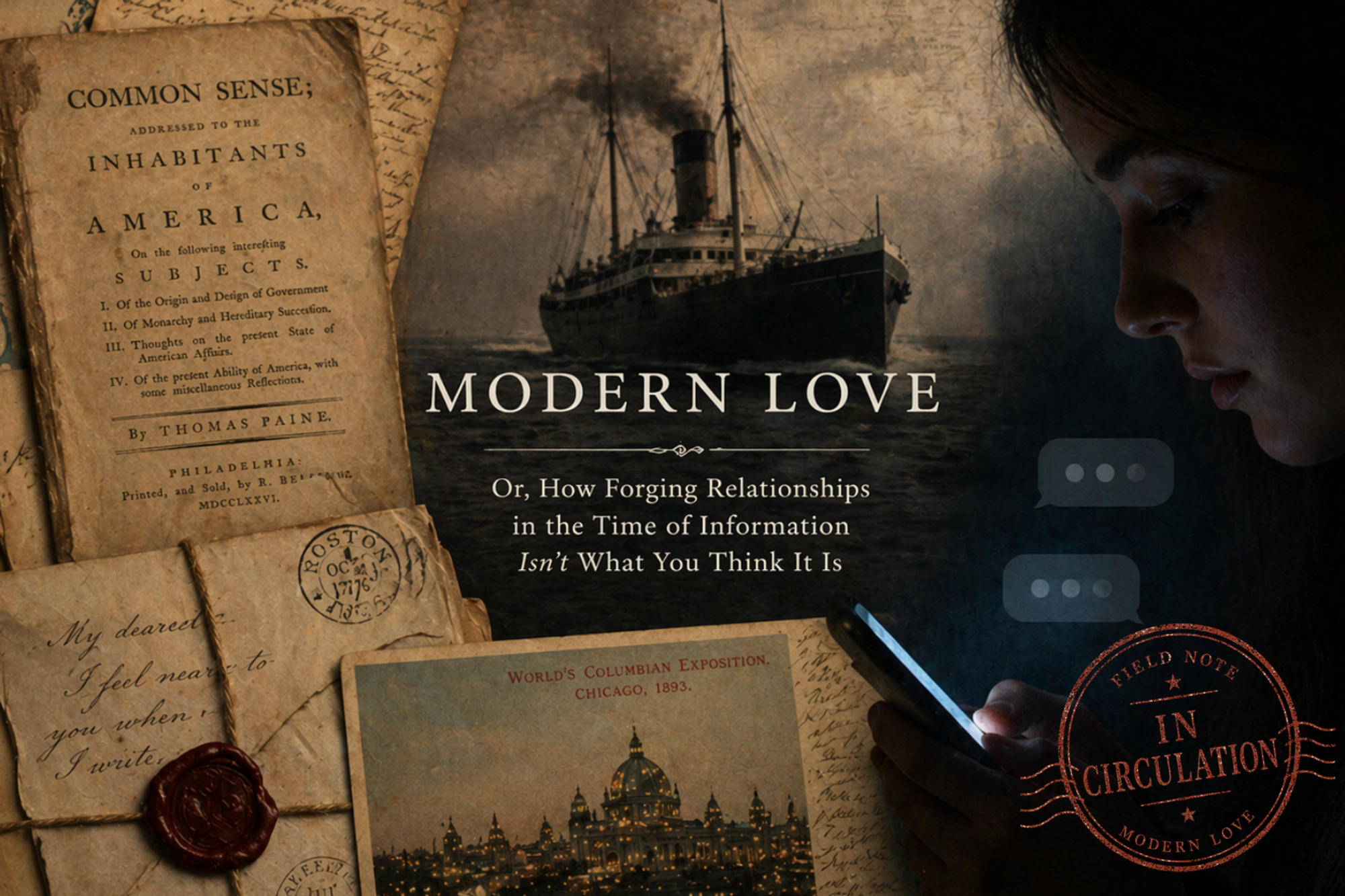
Author’s Note
Most of my writing under The Networks We Need looks at structure at institutional scale: how funders, agencies, and movements form coherent ecosystems, or fail to.
The frame is simple: connection without architecture produces noise. The work is to make invisible structures visible enough to act on.
This essay applies that same frame to relationships.
The mechanics are not different. A donor network without legible relationships behaves much like an inbox without filters. A coalition without shared context fragments in ways that are not so different from a friendship stretched across too many parallel channels.
The scales differ. The structure does not.
I wrote this partly because the personal version is the one most people already feel. If modern intimacy often registers as too much contact and too little coherence, then the institutional version is not abstract.
It is the same pattern, one order of magnitude up.
The Present Tense
There is a small, almost imperceptible sound that has come to define contemporary connection: a soft chime, a vibration against a wooden table, the faint illumination of a phone screen.
Someone has typed something. Or maybe they haven't. Three dots appear, vanish, return.
In a few seconds, a person can move through anticipation, confusion, and disappointment, an entire emotional weather system contained inside a notification bubble that may hold nothing at all.
This is the illusion modern communication has perfected: the sense of connection without the substance of it.
It is now possible to reach almost anyone, anywhere, at any time. That reach, however, does not necessarily produce clarity or closeness. Messages move faster than interpretation. Contact expands while meaning thins.
To understand why modern love feels so paradoxical, it helps to look backward. Not nostalgically, but structurally.
For most of human history, connection was shaped by constraints. Distance, delay, and physical presence imposed a kind of discipline on communication. Meaning accumulated slowly. It had to.
Today, those constraints have largely disappeared. Bandwidth is effectively infinite. The inbox never closes. The number of possible connections has expanded beyond anything earlier systems required us to navigate.
As those limits fell away, something less visible began to erode.
Connection has not disappeared. Its architecture has changed.
This is a story about how that happened, and what it might take to rebuild something that can hold.
Once Upon a Firelight: A Species Built for Small Circles
Fifty thousand years ago, a young hunter returns at dusk with news of an injured elder. He kneels beside the fire, and every member of the small band leans in. The story he carries may determine what happens next.
There are no parallel channels. No background feed. No partial attention.
Communication in this setting is not casual. It is binding.
Anthropologists estimate that early human social groups tended to cluster at sizes small enough to maintain shared understanding. Within those circles, communication carried consequence. Each person's role was legible. Silence itself could be meaningful.
Human cognition developed under these conditions. It favors context, repetition, and relatively stable networks of relationships.
That orientation has not changed, even as the environment around it has.
Letters Across Oceans: Slow Intimacy and the Architecture of Waiting
For centuries, communication remained slow and embodied. Messages moved by foot, horse, or ship.
Distance imposed delay. Delay shaped meaning.
A letter in the eighteenth century was not simply information. It was an event.
Eliza Hamilton seals a letter and sends it across the Atlantic, knowing weeks will pass before it is opened. When Alexander reads it, the paper has traveled farther than either of them could in that time. The message carries not just words, but the conditions under which it was written.
"You engross all my thoughts. I meet you in every dream."
The emotional force of that sentence is inseparable from the delay that surrounds it.
Similarly, Abigail Adams once wrote, "I feel nearer to you when I write."
Writing itself functioned as a form of presence. The act required attention. The response required patience.
The waiting made the words possible.
Silence, in this context, was not automatically a signal of absence. It was part of the structure that allowed meaning to develop.
The First Viral Messages: Bells, Pamphlets, and Paine
Before broadcast media, information moved through shared physical space.
Church bells marked time and signaled events—births, deaths, danger, worship. A single sound carried across a town, but its meaning depended on those who heard it together. The signal did not travel far, but it bound a community into shared awareness.
News worked in similar ways. Town criers delivered announcements in public. Broadside ballads carried political ideas through song, requiring a voice and an audience. Information spread, but only through moments of assembly.
Pamphlets extended this pattern.
When Thomas Paine’s Common Sense appeared in 1776, it spread rapidly through the colonies. Hundreds of thousands of copies circulated in a population where many more could not read. The reach of the text depended on how it moved: passed from hand to hand, read aloud in taverns, debated in rooms where reactions unfolded in real time.
A single copy might reach dozens of listeners. The act of reading was also the act of interpretation.
Amplification and assembly were the same process.
As messages scaled, relationships did not fragment. They gathered. The context in which ideas were received remained shared, even as their reach expanded.
Switchboards and Trenches: When Connection Outran Geography
By the early twentieth century, communication began to accelerate.
A switchboard operator connects a call between continents. The line carries static along with the voice, but it is enough to confirm that someone is still there.
At the same time, letters continue to move through slower channels.
A soldier writes from the front: "When I write, I feel for a moment as if nothing could hurt us."
The message may arrive long after it is written. It may arrive out of sequence with the events it describes.
Even so, the delay does not strip the message of meaning. It shapes it.
Communication has begun to outrun geography, but not time.
Enter the Infinite Buffet: When Choice Replaced Structure
By the late 1990s and early 2000s, the underlying logic shifts.
Email reduces delay. Online platforms reduce distance. Early dating sites expand the pool of possible connections.
For the first time, an individual can browse hundreds of potential partners in a single sitting.
A woman scrolls through profiles late into the night. She sends a few messages, drafts several more, deletes them, and eventually closes the screen without feeling any clearer than when she began.
The exhaustion comes not from rejection, but from the volume of options.
Research on decision-making describes this as choice overload. When the number of options exceeds a certain threshold, the ability to select meaningfully begins to degrade.
The issue is not simply abundance. It is the removal of constraints that once made decisions legible.
When everything is available, nothing feels chosen.
The Age of Ambient Intimacy: When Visibility Replaced Presence
Social media extends this shift further.
A message can be sent instantly. A response can be observed, or not, in real time. The absence of response becomes part of the signal, though its meaning is often unclear.
A person replies to a story. The message is seen. No reply follows. A new post appears moments later.
The interaction exists within a broader field of activity. The recipient is engaged, but not necessarily in the same channel, or at the same level of attention.
Under these conditions, visibility begins to stand in for presence.
Contact increases. Interpretation becomes less certain.
The "typing…" bubble is the spiritual descendant of the wax seal. It carries none of its weight.
Signal and Noise: When Context Overwhelmed Meaning
Consider a familiar uncertainty: a message is sent, and no response comes.
In a low-noise environment, that delay might carry a relatively clear meaning. It could suggest distance, hesitation, or preoccupation.
In a high-noise environment, the same delay becomes ambiguous. It may indicate distraction, competing demands, shifting attention, or simple oversight.
The signal itself has not changed. The surrounding context has expanded.
Information theory describes this as a change in the ratio between signal and noise. As noise increases, the effort required to extract meaning from a signal also increases.
Modern communication environments are dense with competing inputs. Messages arrive alongside notifications, feeds, and other streams of information. Each one draws on limited attention.
Under these conditions, interpretation becomes less stable.
What appears as inconsistency in a relationship may, in part, reflect the complexity of the environment in which that relationship is unfolding.
Reclaiming Structure: What Modern Love Requires
If this were simply a story about technology, the response might be to withdraw from it.
That is not the only option.
For most of human history, the structure that supported connection was built into the environment. Distance and delay imposed boundaries automatically.
In their absence, structure must be introduced intentionally.
This can take many forms. It may involve limiting the number of active channels, creating clearer expectations around response, or choosing contexts in which attention is less fragmented.
It may also involve tools that help make patterns more visible.
Work in network science and organizational systems has shown that complex relationships often become easier to understand when mapped. Clusters, gaps, and flows of influence can be seen more clearly when they are externalized.
The same principle can apply at smaller scales.
The goal is not to reduce relationships to data, but to restore a degree of legibility.
Love does not depend on scarcity. It does, however, benefit from some form of container.
The Next Ten Words After "We Need Connection"
It is common to hear that the solution to fragmentation is more connection.
The phrase is appealing, but incomplete. The next ten words matter more than the first five.
Connection without structure can amplify noise rather than reduce it. Collaboration without clarity can produce activity without direction.
The more useful question is not whether there is enough connection, but whether existing connections can support meaning.
The next step is rarely more volume. It is better form.
Closing: One Real Connection
A phone vibrates. Another message arrives.
Most signals pass quickly through attention and disappear.
Occasionally, one does not.
The difference is not always speed or timing. It is often the context in which the message is received. A message that arrives within a relationship marked by clarity, consistency, and attention is easier to interpret. It has somewhere to land.
Love has never depended on how many people we can reach. It depends on whether we can attend long enough for meaning to take shape.
Modern love is not necessarily more difficult than earlier forms. It is unfolding within a system that requires different kinds of structure.
Understanding that system may be the first step toward building something that holds.
Selected References & Influences
This piece draws on a mix of research and long-running ideas about how humans connect:
- Robin Dunbar — Grooming, Gossip, and the Evolution of Language (1996); How Many Friends Does One Person Need? (2010). Foundational work on cognitive limits of human social networks (often referred to as "Dunbar's number").
- Sheena Iyengar & Mark Lepper (2000) — "When Choice Is Demotivating: Can One Desire Too Much of a Good Thing?" Journal of Personality and Social Psychology. Classic study demonstrating the effects of choice overload on decision-making.
- Claude Shannon (1948) — "A Mathematical Theory of Communication," Bell System Technical Journal. Introduced the concept of signal-to-noise ratio, foundational to modern information theory.
- Sherry Turkle — Alone Together: Why We Expect More from Technology and Less from Each Other (2011). Explores how digital communication reshapes relationships, intimacy, and emotional life.
- Marshall McLuhan — Understanding Media: The Extensions of Man (1964). Origin of the idea that "the medium is the message," emphasizing how communication technologies shape human perception and society.